About us...

ACCI flows from the knowledge that Cree culture must be captured, maintained, shared, celebrated, and practiced. Cree Elders have spoken of the need for a central place for the protection of the way, and have developed a vision for Aanischaaukamikw over several decades.

Apr 9, 2020

My work in the library at Aanischaaukamikw


by: Annie Bosum

Annie will be retiring from her library position in the coming few years so we asked her to write a few words about her career so far.

Me (right) and my colleague Laura (left) in front of the beautiful Aanischaaukamikw building in June 2018.

My position as Library Technician at the Aanischaaukamikw library has been a rewarding experience.  In addition to the cataloguing, circulation, book weeding, and all the other responsibilities that come with maintaining the library, my work includes writing blogs, articles for our regular Air Creebec inflight magazine feature, contributions to journals and reports about the library.

One of the articles I wrote for the Air Creebec inflight magazine.


Our collection relates to the history, culture, language of Eeyou Istchee, and has expanded rapidly since our grand opening in November 2011. Some of the retired anthropologists who lived and worked within the Eeyou Istchee territories donated their research material publications to the ACCI library.  Today, we continue to receive donations from retired or deceased anthropologists and priests. We also purchase materials and have a unique Rare Books Collection. As of April 2020, we have over 4300 items in our entire library collection which includes a circulation collection, a rare books collection, periodicals, audio and visual materials and digital items. In addition to this we have a reference collection that is not catalogued yet. 


Some of the books in the library. 

Ashley Dunne, a former library assistant, and I co-wrote an article about the Brian Deer Classification Scheme which was published in the periodical Collections Management in 2017.  The Brian Deer Classification Scheme is the classification system I use to classify the library material collection. I’ve been invited to speak about using this system at conferences across Canada. I wrote another blog about attending the 2019 Saskatchewan Indigenous Cultural Centre conference ē-micimināyakik

An example from our BDC system - our current version is available on a blog I posted in Spring 2017.

Giving a talk at a conference in Saskatoon in May 2019 - see my blog post for more information.


Giving a talk at Concordia in 2018 for the Quebec Library Association.

 I participated in our talking circle at the 2018 Canadian Museums Association conference in Vancouver.

It is hard to choose between writing and cataloguing in my work (my love of poetry writing is something that is very special to me) but for the sake of work I have to say that cataloguing new books that arrive at the library is like Christmas to me!  I love immersing myself with a great book and looking at the old photographs especially when it is about the people of Eeyou Istchee.


Our book shelves are getting full! 

To some people (more particularly for people who don’t have cataloguing training) the task of cataloguing may look repetitive and boring, but for me, I find it fascinating. What I enjoy the most is when I have to research to find accurate cataloguing information, especially for the old publications published before the 1970’s.  Cataloguing older books is most challenging when the International Standard Book Number (ISBN) is missing.  The ISBN is the easiest and quickest way for the librarian to find a book in order to accurately classify and catalogue the item and this number means I can do copy cataloguing of the record which makes me efficient at my job.

My main achievement in 2019 was completing our first full inventory. I began the inventory of the circulation collection (approximately 2000 books) and periodicals in September 2019 and completed it in March 2020.  I worked on the inventory whenever I was not occupied by other tasks.  For instance, visitors who came to the library are important clients and had to be given first priority because I am usually the only staff member present who is knowledgeable about our library collections.  


Working on the inventory.

Working on the inventory was very exhausting physically and emotionally. I say ‘emotionally’ because when I did not find a book I worried that it was missing, ha ha! Sometimes it turned up on a different shelf. For the next time, I will use a laptop so I can have it with me amongst the shelves to check and update records immediately. I felt a lot of time was wasted by going back and forth to the shelves to fetch the books and my desk to check on our library database, M2L, and looking at my printed inventory list. Kyle from MINISIS, the database company who provide M2L, and my colleague Laura helped me make the inventory report. I used my book carts a lot to take books back and forth to double check their catalogue records.


Using my book carts for the inventory.


In action - checking the inventory.

I remember the day I completed the inventory. I was so happy and it was so rewarding to finally complete such a huge task on my own. We do the full Inventory every 2 years so I will probably do it one more time before I retire.   

Whenever we can go back to work after the pandemic I’ll start cataloguing the Reference section. For now, I am working from home on and enjoying time with my family.

Mar 30, 2020

Building on My Skill Sets: Life as an Intern September 2019-February 2020


My Young Canada Works internship with Aanischaaukamikw Cree Cultural Institute (ACCI) as the Collection Assistant was filled with many different kinds of scholarship and opportunities to learn a variety of new things on the job. It has been an amazing opportunity getting to work with different staff members and learn from them; not only about the jobs they do but about the wonderful community of Ouje Bougoumou.
Being a member of the Collections team meant we had to design and build a display stand for My Grandmother’s Garden, a large framed artwork on loan to the museum from Flora Weistche of Waskaganish. This project was one of these skills building moments. The project was a labour of love and a group effort between the Conservator, the Registrar, the Programs Director and the Facilities Director. Each person had different idea and concerns and we all came together to create a sensible, sturdy and safe stand to support the artwork. This was an excellent demonstration to me of the types of teamwork that are required in museums.  Personally, it was a chance to work on my power tool skills and brush up on my math abilities to make sure everything lined up. 

Building the stand for My Grandmother’s Garden by Flora Weistche. I’m holding the support board while Jessica MacLean drills the board into place.  Photograph by Melanie Banks.
My Grandmother’s Garden, on completed stand in the entrance area of Aanischaaukamikw. Photograph by Chanelle Fabbri.
Over my 19 weeks of being an intern, I had a chance to work independently on a couple of projects, one of which was constructing mounts for the many snowshoes in the museum’s collection. Space in the secure storage area is at a premium, so it is paramount that all available space is used to its greatest potential. 
As of 2020, Aanischaaukamikw has over 30 pairs of unique, hand made snowshoes in the collection, many of which have come in with details about their makers and the specific details of how they were made, like the type of wood and sinews used. But for collections management, snowshoes are one of the worst culprits for occupying horizontal space on shelves but leaving plenty of vertical available above them. In order to fix this problem, I made mounts and spacers so two sets of snowshoes can be stacked on top of each other, without putting any pressure on the lower pair, therefore occupying space that was previously home to only one set of snowshoes. Aanischaaukamikw is well on their way to having the world’s largest Eeyou snowshoe collection, so more storage solutions will be needed in the coming years. 

I’m placing a mount on a pair of snowshoes. Photograph by Melanie Banks.
To see more snowshoes be sure to check out the online database:   cree.minisisinc.com

Not all of my work tasks were hands on with collections, some tasks were procedural. For example, I was given the opportunity to do much needed updates to the photography procedure document. I expanded this document to provide detailed instructions for any staff member or intern on how to photograph and organize the digital files for any object / belonging in the ACCI collections. This document will provide continuity to all future collections photography, to make sure there is consistency in file naming and where to locate the files. Part of this process included experimenting with how to take photographs that are very crisp and detailed, so that they can be used for multiple purposes in the future. 


My favorite part of my 19 weeks with ACCI was the ability to work with and learn from different people and departments of the cultural centre. Living in Ouje Bougoumou over the winter was  a bit of an adjustment from where I grew up, in southern Ontario, but it was a very  positive experience overall. I would encourage museums studies students to think of ACCI when looking for an internship opportunity, because it is a unique and special place to immerse yourself in Eeyou culture.   

By: Chanelle Fabbri, YCW Collections Intern 2019-2020

Mar 26, 2020

My Life as a Digitization Technician in Eeyou Istchee


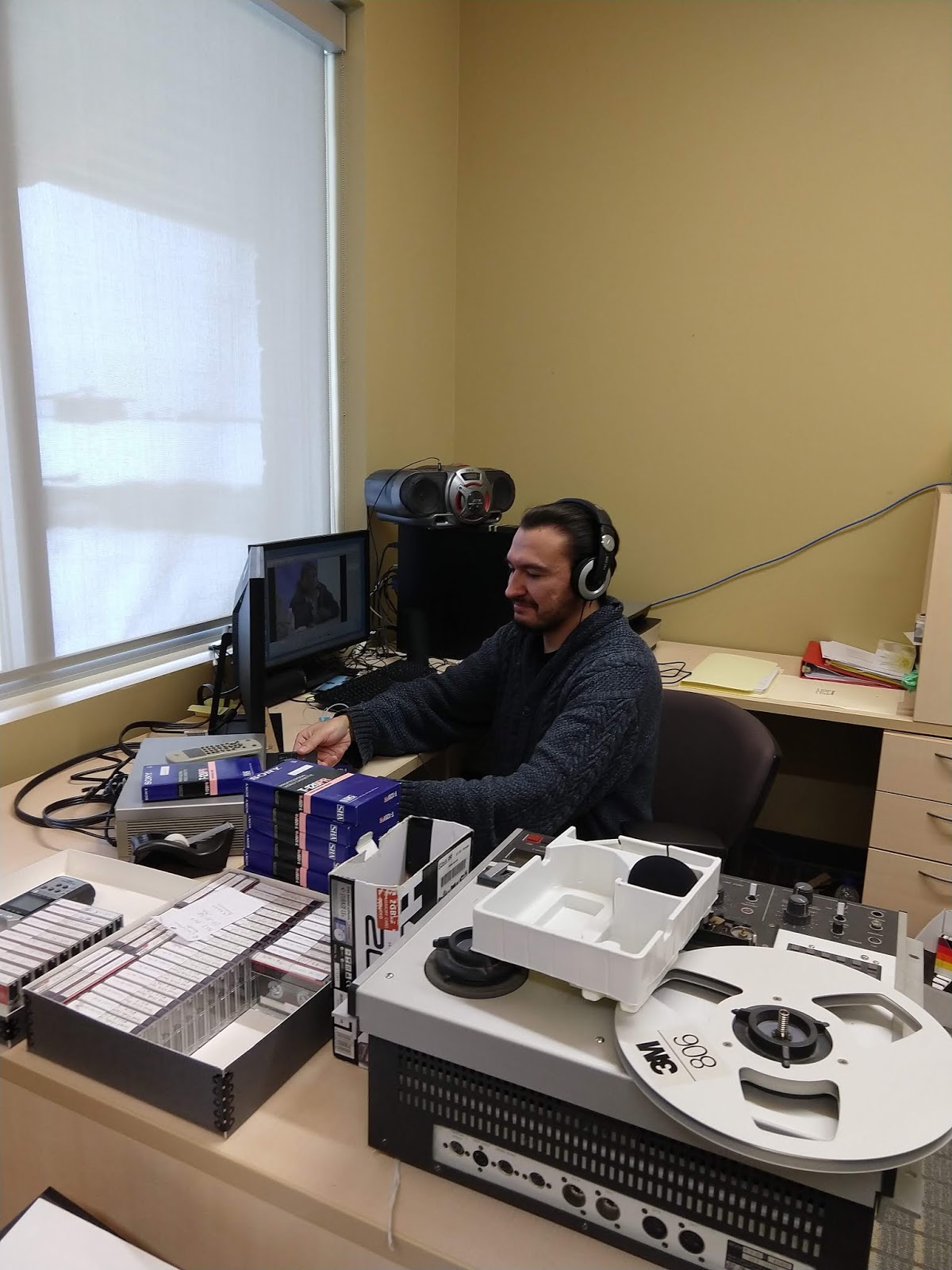
Kory at work doing digitization
As a digitization technician at Aanischaaukamikw Cree Cultural Institution, my primary task is essentially to preserve material from the archives and convert each original file into a digital file.


VHS tapes that need to be digitised

From a profusion of textual documentation to old school playable video and audio formats, this is a pivotal position.

Since I’ve started working at Aanischaaukamikw*, I have had the liberty to access materials and dissect its information. Being part in the preserving process is imperative. Some of the collection requires an extensive amount of care, which makes working at a museum ideal.


Learning to fix a VHS tape so it could be digitized

For instance, one of my practices is analyzing audio and video formats. This is the essential part before inserting any playable formats into a device. If a format is not analyzed, it can be detrimental to our equipment. With that said, acquiring or requiring equipment to our digitization department isn’t as easy as it sounds. 


Equipment we use to digitize 


Firstly, we need to assess used and/or discontinued devices, of which requires specificity on the conditional state of equipment we may be investing. However, we do accept donations on certain types of equipment to advance our department.

Aside from only digitizing materials, digitized files are then transferred to a database, which can be made accessible to a search engine (cree.minisisinc.com). It is basically history on our fingertips. 
With that in mind, it is the most convenient tool for researchers or for a curious mind. Each file holds a significant part of history.

Some of the archives waiting for digitization


The content will only expand as we continually digitize and catalogue the material that’s been donated. 

If you think you may have something valuable culturally, do not hesitant to contact Aanischaaukamikw. We’d be happy to hear from you.

At this point in my tenure, I’ve only scratched its surface. 

As a Cree person, I am intrigued to acquire and learn more information as I continue to preserve what lies in the archives. It is what entices me to play my part in a significant role as a digitization technician.
More digitization equipment


Kory Saganash, Digitization Technician

Nov 29, 2019


My internship in the Collections department at Aanischaaukamikw Cree Cultural Institute, 2018

By: Camille Crevier-Lalonde

My work as an intern as part of my course in applied museology at Montmorency College often consist of solving problems to support and display objects that may have specific requirements or restrictions. Making a mount is always about the condition of the object, the center of gravity and the structural stability of the object.

During my internship I had the occasion of making storage mounts for a variety of objects, some of them representing more of a challenge than others. My favourite mount making experience was with child’s pants worn during a walking out ceremony.

 
On loan from Trifona Simard, SIMARD-2016-2

  
The first step was to construct padding for the leather pants. Measurements had to be taken for sewing small pads of synthetic fabric (Tyvek- high density polyethylene material padded with polyester fibers). The padding is useful for the object : the weight of the leather is distributed equally on the padding, causing less stress on the object and maintaining the fabric in a position that resemble the natural position of the object before it came on loan.

From the perspective of conservation, organic collections are the most fragile material types in a museum. Light, temperature/humidity variations and insects may deteriorate any leather object: that is why it is important to use stable materials and non-acid fibers (like Tyvek) that will keep the objects from deteriorating.

As an intern, I learned that the objects do not always need as much support as we would think. Additions of material may cause stress on a fragile object. Some leather ornaments, such as leather fringes, can be hard to present directly on a mount, because they are made of a malleable fabric. Sometimes, the object is a good mount in itself for these ornaments. In the picture below, we can see that the pants are supporting the fringes well.


The second step was to construct a tray for supporting the object in storage. The pants were installed on a rigid support, consisting of non-acidic Hollinger board, covered with a layer of microfoam and acid free cotton fabric. The fabric had been pinned to adjust equally the tension of the textile on the mount, then taped at the back of the board, with acid free tape. The pants were held in place on the board with cotton ribbons.

This Hollinger board provided an easy way of supporting the pants in storage; the pants can now be observed without any movement of the object itself, which is good for the prevention of any damage during storage.

Nov 5, 2019

Attending the 2019 SICC ē-micimināyakik Gathering by Annie Bosum


Attending the 2019 SICC ē-micimināyakik Gathering by Annie Bosum

I had the honour to attend the 2019 SICC ē-micimināyakikGathering hosted by the Saskatchewan Indigenous Cultural Centre in Saskatoon May 2-3, 2019. There, I presented the Brian Deer Classification System, which we are using in the Aanischaaukamikw Library and debriefed on the functions and spaces of the Aanischaaukamikw Cultural Institute.

Annie at the conference, from the SICC event Facebook page

 This two-day indigenous gathering was held at the Ramada By Wyndham Saskatoon with various keynote speakers, panels and workshops.  The event provided opportunities for sharing indigenous knowledge and networking from curators, archivists, librarians, researchers and museum professionals.  It was also a great way to share issues, ideas, progress and solutions for First Nations museums, cultural centres, archives, interpretive centres and libraries.  It was very interesting to see all the different indigenous nationalities coming together to share their knowledge, expertise and their ways of preserving and protecting their cultural heritage.  Among the nationalities who participated in this event were Plains Cree, Nakoda, Ts’msyen/Cree , Haida, Dene, Metis, Chippewa,, Pueblo, Saulteau, Anishinaabe ,Cree and Mohawk!

The first day opened with an early morning pipe ceremony by Elder William Ratfoot proceeded by opening remarks by the emcee, JR McArthur, the Federation of Sovereign Indigenous Nations,  the SICC Board of Governors Chief Alvin Francis and SICC President Wanda Wilson.  The first day was relaxing for me- I wasn’t on any of the panels and workshops-which I was happy with because I was still tired from all the travelling.  I had the wonderful opportunity to sit and listen to some good presenters on the subjects of Indigenous Intellectual Property : Arising Questions by Val Napoleon, Saulteau and Indigenous Collections: Valuing Our Cultural Heritage and Intellectual Property by Sean Young , Haida and Robin Gray, Ts’msyen/Cree.  Elegant and nourishing lunches were served both days which made it easy for the delegation to return to their panels and workshops.  There were five workshops and two panel discussions were held in various rooms throughout the afternoon.  One of the panels I got to listen to was entitled: Preparing Our Peoples: indigenous Education in Cultural Preservation & Property Law by Jessie Ryker-Crawford, Filipe Colon, and Val Naploeon.  The gathering ended with a thank you prayer by Elder William Ratfoot.

Annie at the event, from the SICC Facebook event page.

 The second day I was a bit apprehensive knowing I had to participate in two presentations, the first was at 10:30 am and the other at 1:00 pm.  I quickly felt at ease when I met my first workshop partner, Audrey Dreaver because of her warm and kind personality. When I entered the room where we did our workshop, she was already sitting with the coordinator putting together my slide, she looked at me sitting in the audience and she says, “Annie get up here, I’m not sitting here by myself!“  The audience laughed with us!  Our Workshop presentation was called: Politics of Museum Technology: Labels & Categorizations of Indigenous Material Culture.  The second presentation I participated in was on Panel 3 where I was supposed to sit with Del Jacko and Hillary McLeod who were both Anishinaabe.  I got confused with all the different rooms, I ended up in the wrong room and by the time I got to the right room my partners were a little into their discussion so I told the coordinator I didn’t want to distract them so I had to do my presentation alone.  I was nervous at first but as I looked at the huge audience in front of me and saw their interest manifested on their faces, I switched my focus away from myself to a need to give them what they came there for.  

Our Panel discussion was called: Access to Indigenous Cultural Knowledge (Archival Material).  A few people approached me after my presentation to give me their business cards, and told me they enjoyed my presentation-one even requested to send them my slides! Unfortunately I was unable to discuss the Brian Deer Classification System poster in detail due to time restraints.  I was disappointed that I was unable to listen to all the other workshops and panel discussions that were held in various rooms.  All in all, I really enjoyed this conference and meeting all the people.  It was a great learning experience- which goes to prove – learning is a life-long achievement that is to be appreciated and taken when it arises and I am glad that the Saskatchewan Indigenous Cultural Centre (SICC) and the Aanischaaukamikw Cree Culture Institute made this learning experience possible for me.  It was a proud moment and an awesome closure when the President of SICC, Wanda Wilson said to me.  “I like what Aanischaaukamikw is doing and we are coming to visit your community!

Nov 19, 2018

Beginning of my adventurous Internship - Alycia Lameboy-Dixon

This past summer I worked as an archives intern at Aanischaaukamikw. My main tasks were to research existing archives in institutions and organisations in Gatineau, Ottawa and Montreal, to gather digital copies of the material for researchers to use when they visit Aanischaaukamikw. I was included in some of the other activities that Aanischaaukamikw had organised over the summer. For example, I was fortunate to have the opportunity of visiting a few of the painted caribou coats at the Canadian Museum of History, and the National Gallery of Canada, in June 2018 - by far, my favourite adventure of my summer internship. 

This research trip was organized by Aanischaaukamikw Cree Cultural Institute and funded by the Canada Council for the Arts, as part of a bigger project to rediscover our traditions of painting on caribou hide in Eeyou Istchee. Delegates, including Elders and young adults like myself were from Whapmagoostui, Chisasibi, or Wemindji, travelled to Gatineau-Ottawa for this event.

Photo 1: Our group [L-R: Donny Dick, Matthew Iserhoff, Matthew Mukash, me, Natasia Mukash, Jean Masty, Jane Matthew, Nancy Sheshamush, Lawrence Matthew, Jerry Gull, Emily Sam, Charly Gilpin]. We are standing in front of the mirrored abstract image of the Aanischaaukamikw building that is in one of the corridors at Canada Museum of History. Photo: Laura Phillips

Our first museum visit was at the Canadian Museum of History [CMH]. Honestly, I didn’t know what to expect. I mean, what do you expect when it’s your first time being behind the scenes in the museum? When I walked into that room, I saw a field of painted coats along with different objects laid out on tables.  I was too amazed to believe what was in front of me at that moment. I was scared to break anything if I touched it. The Elders discussed the painted coats and I learned some of the history of the coats in our region. We went on a tour to see the museum’s cold storage rooms (used for furs and organics) and the storage room for oversized collections like skidoos and toboggans. 

These are some of the highlights from that day:

       Here is a photo of a women’s cap made by Mimie Cheezo from Eastmain, Quebec in 1962; A pair of female leggings (used for 2 generations) made by Daisy Cheezo from Eastmain, Quebec in 1962; A band for a shell bag made in 1963 by Louise Cheezo also from Eastmain, Quebec.
Photo 2: Woman’s cap [III-D-156] made by Mimie Cheezo, Eastmain, 1962. Photo: Alycia Lameboy-Dixon.


Because of the sequence of absorbing new information, as much as my day felt very long, I learned so much. I spent a few hours just googling the definition of the terms I heard that day.


Photo 3: Woman’s leggings [III-D-115] made by Daisy Cheezo, Eastmain, 1962. Photo: Alycia Lameboy-Dixon.


Photo 4: A band of a shell bag [III-D-214] made by Louise Cheezo, Eastmain, 1963. Photo: Alycia Lameboy-Dixon. 
The second day was interesting in different ways. With the help of the curators and other collections staff at CMH, the coats were gently flipped over so we could see the designs on the back. Elder Jane Matthew from Chisasibi shared her memories with everyone, and the stories she heard from her grand-parents, that they heard from their grand-parents. I was standing nearby Emily Sam (daughter of Jane and Lawrence Matthew) as she was analyzing the designs on the painted coats. 
    
Emily shared with me that back in the day, our chief would be given a ceremonial caribou hide coat with painting on it. The Elders think our ancestors used lines to represent path ways, the dots to represent people that the chief led and if you look closely, you can see the symbols, or nearly read their story. 


Photo 5: Painted caribou coat [45973] on display at the National Gallery. Photo: Alycia Lameboy-Dixon.
On the third day of our trip, we spent our morning visiting the National Gallery of Canada [NGC]. The NGC curator and the exhibition coordinator introduced themselves and presented the painted coat that is in the Indigenous Arts Exhibition. There is no known information about the maker of the coat, apart from that it is called 'Naskapi', like all coats of this kind - however, the research project is uncovering many links between these coats and Eeyou Istchee (more details to come on that when research is in later stages). 

The details on this coat are captivating. Although handling of the object was limited, I think everyone was in awe to see this one.

Throughout the trip, I chatted with our elderly delegates and I learned a lot! My questions came out of curiosity, questions I would never think to ask. What I learned from them was that there is no such thing as asking silly, or too many, questions. Questions are how you show interest in wanting to know about your history, and our elders have so much knowledge and experience to share with us. They answer without judgement, and this is the main reason I enjoyed this trip so much. 

I’d like to thank everyone in the group for this wonderful immersion in Eeyou culture. This experience enhanced my understanding to why we need to document OUR Eeyou / Eenou history, the real stories of our people, from our own perspectives. There is so much of our history that needs to be shared with my generation, as we learn what it means to be Eeyou in 2018. Considering the amount of Indigenous History that is still yet to be documented, we need to get to work using the expertise that we, as Eeyouch/Eenouch, have to interpret our own history using the knowledge passed to us from our ancestors, which we will, in turn, pass on to the next generations.

This summer experience also made me want to shift my career path to focus on museums. Which I think will happen lol …